
Scope Creep Has Never Been This Easy
I have discovered a new occupational hazard of working with coding agents.
It starts innocently enough.
I was working on my blog and thought it would be useful to have a way to listen to an article while I was proofreading it. I already have a local text-to-speech system, so why not add a little player to the local Jekyll site? Select some text, press Play, and listen to it.
That’s useful. That’s a tool.
Then I thought, well, if I can play selected text, I should probably be able to pause it.
And stop it.
And select something else.
And play the entire article.
And if I can synthesize the entire article, why not save it as an MP3?
And if I have the MP3, I could put an audio: field in the Jekyll front matter and automatically add a player to the published article.
Wait.
I was proofreading a blog post five minutes ago.
This is how it happens.
The dangerous thing about Codex and other coding agents isn’t merely that they make software development faster. They dramatically reduce the activation energy required to turn “Wouldn’t it be neat if…” into working code.
A little utility that I might once have put on a list for someday can now be built while I’m thinking about it. Sometimes that’s fantastic. I’ve accumulated a growing collection of little tools that exist because I needed something, described it, iterated on it for a few minutes, and suddenly had it.
There is another problem here: this workflow gets along spectacularly well with my ADHD.
I can finally follow the tangent and have something useful at the end of it.
A tangent no longer has to remain a tangent. I can follow it, hand part of it to a coding agent, and sometimes come back twenty minutes later with an actual working tool.
This is wonderful.
Five hours later…
It’s also how I ended up building an audio publishing system while I was proofreading a blog post.
But there are two monsters hiding in that workflow.
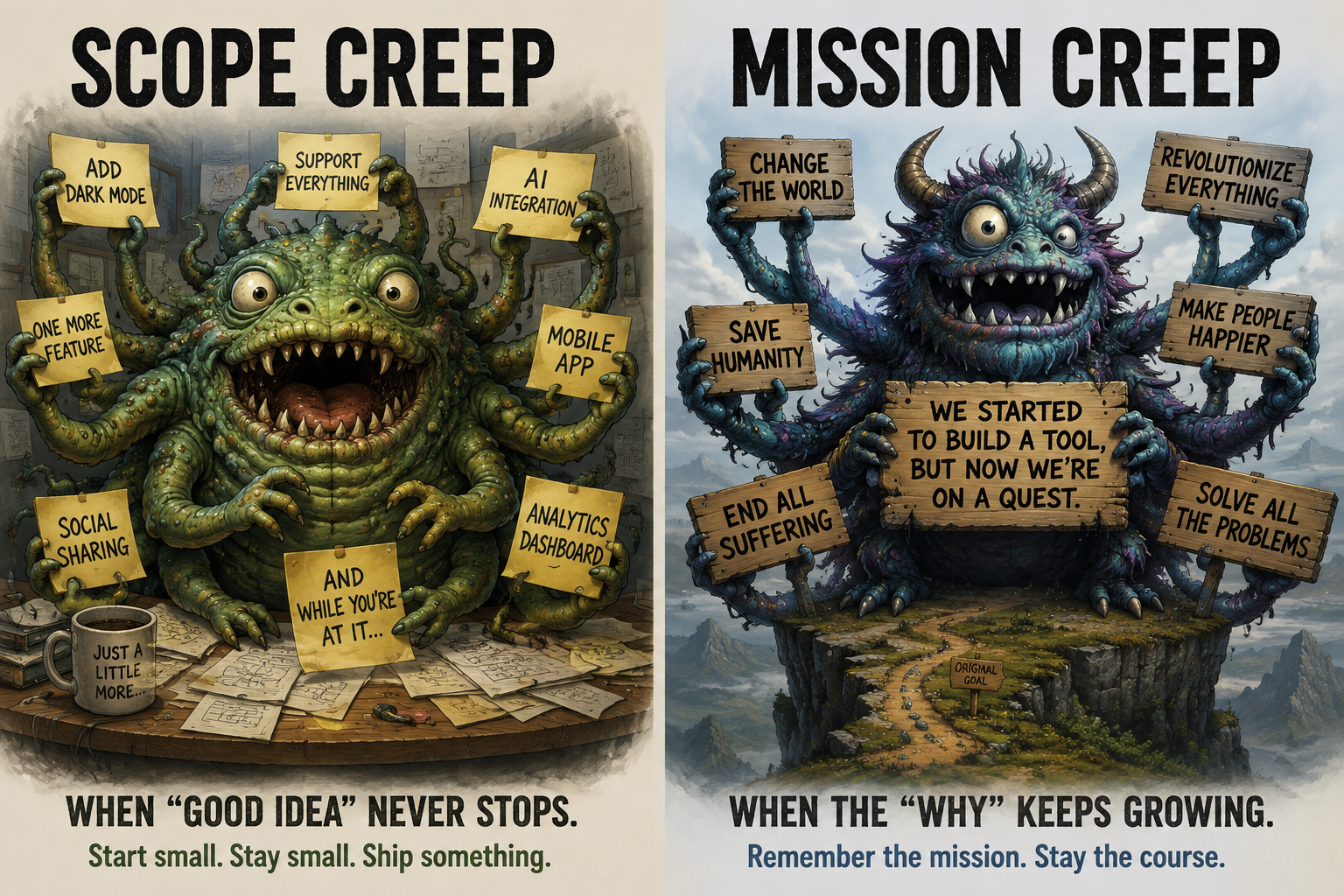
Scope Creep is the obvious one.
You needed a button. Now the button has preferences, keyboard shortcuts, synchronization, analytics, AI integration, a mobile app, and apparently its own product roadmap.
Then there’s its larger and slightly more philosophical cousin: Mission Creep.
That’s when the little tool you were building to solve one irritating problem somehow becomes a platform that will revolutionize software development, democratize artificial intelligence, improve human civilization, and possibly end suffering.
Meanwhile, the original task still isn’t finished.
I’ve caught myself doing both.
The solution isn’t to stop following interesting ideas. Some of my best tools have come from exactly that process. The trick is recognizing when you’ve crossed the line from “this makes the thing I’m doing easier” into “I am now building an entirely different thing.”
Coding agents make experimentation incredibly cheap.
Finishing things is still expensive.
So I’m learning to enjoy the ridiculous new superpower while occasionally asking a very old engineering question:
What the hell was I actually trying to accomplish?
And sometimes the answer is:
I was proofreading a blog post.
That’s probably when it’s time to stop adding features.
Join the Discussion
Comments for this post live in GitHub Discussions. That keeps moderation in one place and gives the conversation a stable home.