
Secrets Kit 1.2: launchd, seckit run, and invisible env vars
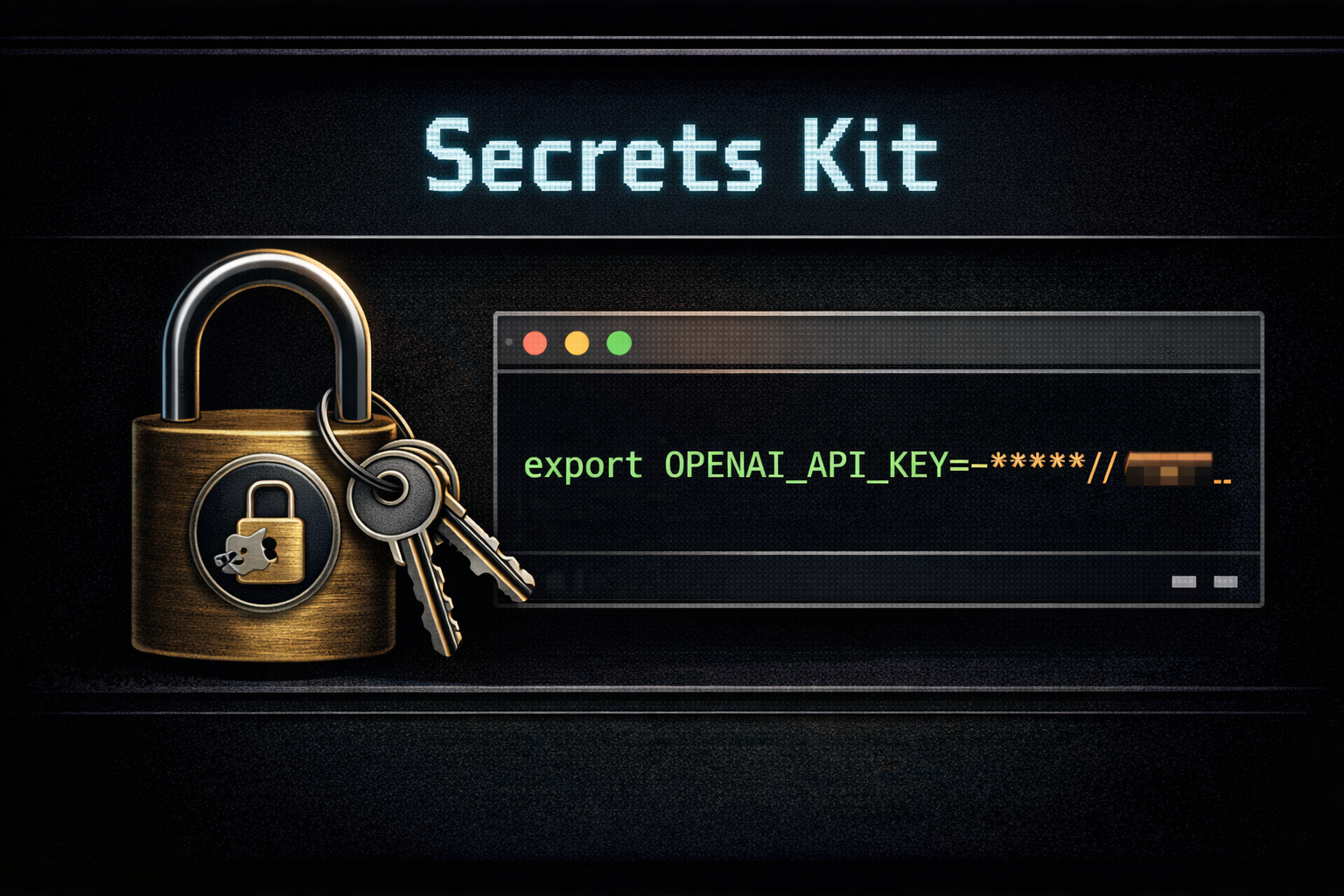
Secrets Kit 1.2: launchd, invisible env vars, and why API keys shouldn’t ride shotgun on argv
Feynman had a habit of boiling things down to what actually matters. If you can’t explain it to a freshman, you probably don’t understand it. Thompson might add: if you’re explaining it while the engine is on fire, bring better tools - because adrenaline is expensive and key rotation is worse.
Secrets Kit 1.2.0 is that kind of release: less spectacle, more structural integrity. The kind where nothing flashy happens, and everything quietly stops breaking.
Here’s the plot.
Most of us learned to pass API keys like contraband in a crowded room: export them in a shell, paste them into a .env, duplicate them into a launchd plist because “it worked once,” and then pretend ps eww is not a thing.
Spoiler: it is. So is your shell history. So is every log line that ever captured argv when you weren’t looking.
seckit run is the workaround that sounds boring until you actually watch it behave.
The parent (seckit) talks to Keychain, pulls the values you asked for, drops them into the child’s environment, and hands off to your real program. The secret never becomes a command-line argument. Nothing gets pinned to the process list like it’s a parade float.
Quick example, same vibe as the docs but slightly more awake with black coffee:
echo 'sk-demo-not-real' | seckit set --name OPENAI_API_KEY --stdin \
  --kind api_key --service my-agents --account launchd

seckit run --service my-agents --account launchd -- \
  python3 -c "import os; print('set' if os.getenv('OPENAI_API_KEY') else 'missing')"
Set defaults once and the launch line collapses into something almost offensively simple:
seckit run -- /path/to/your/actual/binary
That pattern is what makes launchd bearable. launchd is a fine scheduler with a weakness: it loves XML, and XML loves to leak structure the minute you stuff secrets into EnvironmentVariables. So don’t. Make ProgramArguments a wrapper, not a vault.
launchd without the confession booth
launchd is a solid scheduler with one unfortunate personality trait: it happily exposes whatever you feed it.
So don’t feed it secrets.
Make ProgramArguments a wrapper, not a vault:
<key>ProgramArguments</key>
<array>
  <string>/usr/local/bin/seckit</string>
  <string>run</string>
  <string>--service</string>
  <string>hermes</string>
  <string>--account</string>
  <string>local</string>
  <string>--</string>
  <string>/Users/you/.venv/hermes/bin/hermes</string>
  <string>gateway</string>
  <string>start</string>
</array>
Same camera angle for OpenClaw (or any other long-running “always there” agent): seckit run first, then your usual subcommand. The plist stays boring. Boring plists age well.
Operator candy
Shipped alongside the good manners:
seckit version --jsonand--info: for scripts and humans who want to see the world as a small, honest data structure instead of squinting at four different terminal panes.- CI and release hygiene that actually touches every Python the project claims to support - including 3.13 - so “it works on my laptop” stays a joke and not a deployment strategy.
- Cross-host moves stay the adult path:
seckit export→ encrypted artifact →seckit importon the other Mac. No fairy dust. It works in hotel Wi-Fi and in your lab.
Cross-host reality
There’s no magic sync story here, and that’s intentional.
You export, you move the file, you import:
seckit export → encrypted artifact → seckit import
It works on hotel Wi-Fi. It works in a lab. It works when things are slightly broken, which is most of the time.
The iCloud Keychain chapter (honest edition)
We’ve spent real time on synchronizable Keychain paths - native helper, entitlements, the whole song-and-dance - because “synced secrets” is a beautiful idea until the operating system decides your helper is not allowed to have nice things. In plain English: on a lot of macOS builds, the helper can get SIGKILL at launch (taskgated, AMFI -413, pick your villain) even when notarization looks fine. That’s not a Python packaging tantrum; that’s policy territory.
The helper gets shut down at launch:
SIGKILLtaskgated- AMFI complaints
The work is preserved in git on branch preserve/icloud-backend-as-of-2026-05-05 while we wait to hear something useful back from Apple. If the OS opens the door, you’ll see that path return in a shape that doesn’t waste your afternoon. Until then: seckit run, launchd, export/import. It’s less science fiction and more “lunch with the laws of physics.”
seckit run- launchd wrappers
- export/import
Less fantasy, more physics.
Install / peek
pip install "git+https://github.com/unixwzrd/Secrets-Kit.git@v1.2.0"
seckit version
seckit version --info
Repo and deeper docs: Secrets-Kit on GitHub.
P.S. If you already read the gentle introduction post, this is the one where the rubber meets launchd. Same philosophy: fewer secrets on disk, fewer secrets in argv, fewer apologies later.
Join the Discussion
Comments for this post live in GitHub Discussions. That keeps moderation in one place and gives the conversation a stable home.